
Problem: Clothes shopping can be a confidence challenging experience for many shoppers.
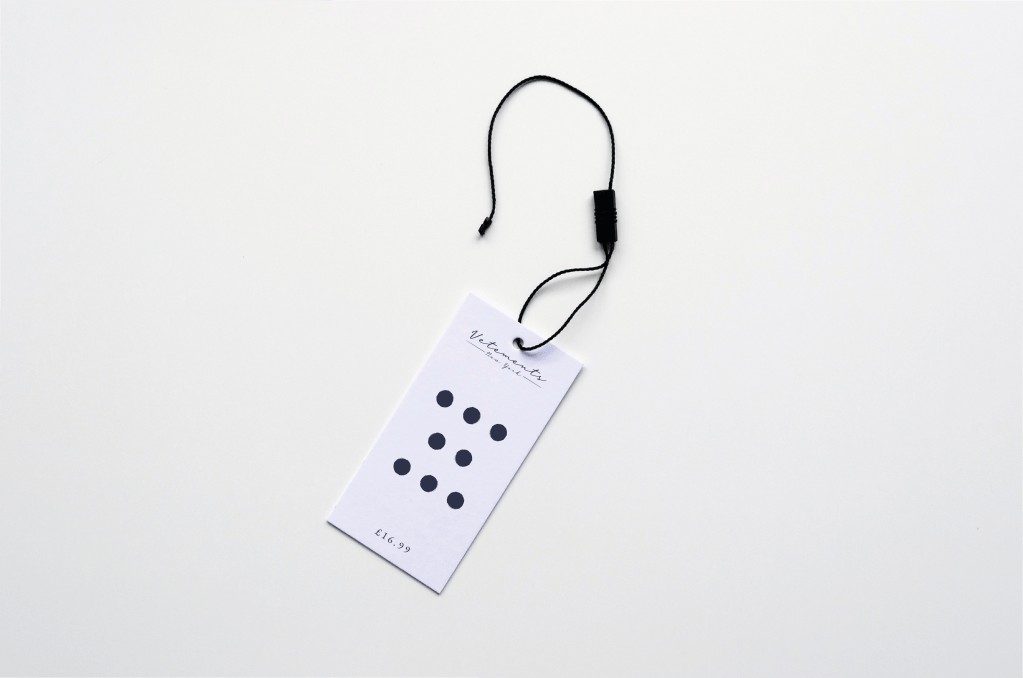
Solution: A clothing tag that provides more information about fit & less direct comparison between different sizes.
The Brief
I was challenged by a fellow designer to address the self-conscious nature of clothes shopping for her and so many other women. Could human centred design be used to instill confidence in shoppers, rather than the self-conscious fear and loathing it causes for so many women?
The Approach
Observations and discussions lead to the categorisation of 2 key problem scenarios -Finding your size on the rail & trying the item on, only to find it doesn’t fit or is unflattering. Both of these scenarios spoke to the same problem: defining all clothing (and thus all women) by a single number on a scale.
By replacing numerical sizes with a diagrammatic sizing system the label is able to demonstrate much more information about the cut & shape of the garment. Each row of dots corresponds to an area of the garment and describes a relative for each area (i.e. broad shoulders, small bust, medium waist). By removing numerical values (and using half dots for each size step) it reduces the gulf between the smallest & largest sizes whilst the additional levels of shape nuance make comparisons between sizes harder and the garments fit clearer.

 Jimie.